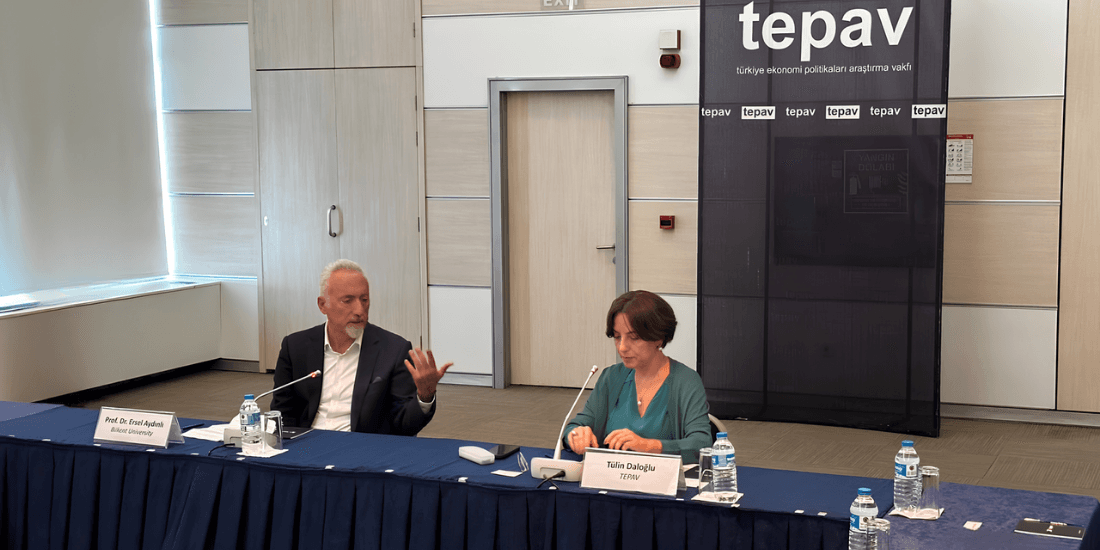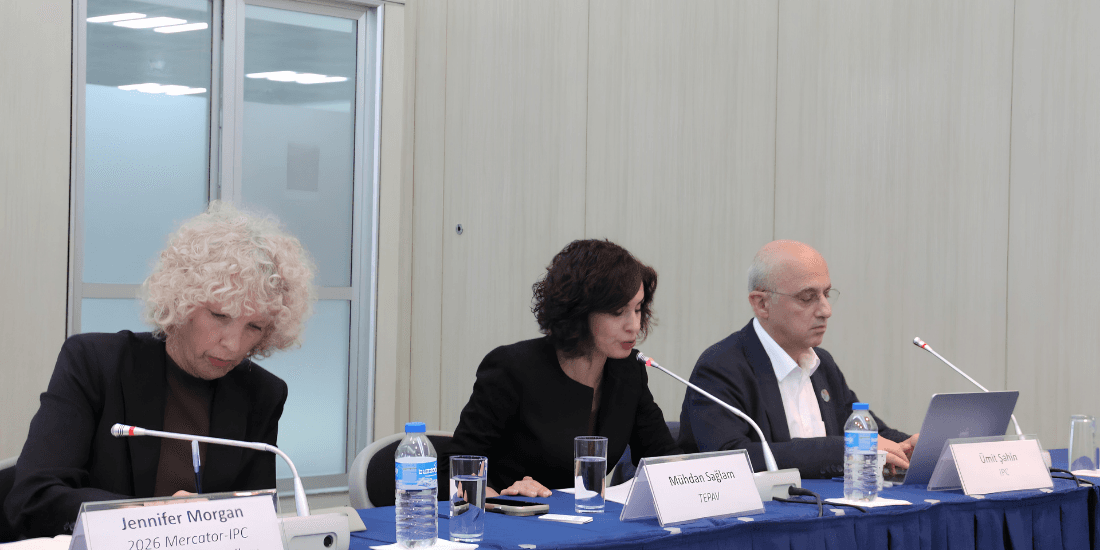
TEPAV and IPC held a panel entitled “The Future of International Climate Governance: How can COP31 respond to the climate and energy security crises?” at TEPAV on 26 October 2026.
Moderated by Dr. Mühdan Sağlam, Director of TEPAV’s Energy and Climate Change Studies Center, the panel featured Jennifer Morgan, 2026 Mercator-IPC Visiting Senior Fellow and Germany’s former Special Envoy for International Climate Action, and Dr. Ümit Şahin, Senior Scholar and Coordinator of Climate Change Studies at IPC.
The event brought together ambassadors and other diplomats, members of parliament, academics, representatives of civil society organizations and political parties, and members of the media.
In opening remarks, Sağlam highlighted shocks affecting global transport and energy corridors, emphasizing the need to address economic resilience, energy security and climate policy together. Sağlam also noted that electrification’s contribution to emissions reduction depends on the sources used to generate electricity.
Implementation and accountability move to the forefront of climate cooperation
Morgan said multilateral cooperation was under pressure, particularly from Trump administration policies. Emphasizing that the Paris Agreement remained operational, Morgan noted that the focus of climate governance was shifting from rule-making and negotiations towards implementation, transparency and accountability.
“International climate action is advancing through bilateral partnerships, initiatives involving groups of countries, green industrial strategies and trade policies alongside United Nations negotiations,” Morgan, Germany’s former Special Envoy for International Climate Action, explained.
Morgan called for COP31 to reaffirm the commitment to a just transition away from fossil fuels and to support clean energy finance, green industrialization and broad participation.
Transition partnerships should support local development
Morgan highlighted the need for economic diversification in producer economies, given the diverging interests of fossil-fuel-producing countries and countries pursuing electrification.
Morgan said transition plans must reflect the role of oil and gas revenues in funding healthcare and education, calling for structured dialogue between producer and consumer countries. “Transition partnerships should create local value and jobs,” she added, stressing the need for equal partnerships that deliver benefits to both sides.
Identifying high borrowing costs as a major barrier to clean energy investment, Morgan called on international financial institutions, multilateral and national development banks to expand instruments and guarantees that reduce investment risks. Morgan also stressed the need to improve access to just transition finance for local institutions and vulnerable groups.
Electrification needs a stronger link to climate objectives
Dr Ümit Şahin said energy security in Türkiye had long been defined in terms of domestic coal resources, which had delayed climate action. Şahin noted that IPC’s modeling showed how Türkiye could reduce emissions and advance decarbonization.
“The link between electrification and the transition away from fossil fuels needs to be strengthened,” Şahin said of COP31’s electrification agenda, calling for renewable energy expansion and energy efficiency improvements to be integral to the effort.
Şahin argued that nuclear power’s high investment costs, long construction periods, and safety and waste concerns would limit its ability to deliver the rapid transformation required. Morgan also stressed the urgency of accelerating renewable energy investment, noting that nuclear projects could not deliver results as quickly.
A broader policy mix is needed to turn climate targets into action
Türkiye’s climate targets were not yet matched by the policy tools needed to deliver them, Şahin noted. A study co-authored by the IPC scholar found that regulatory instruments accounted for about 70 percent of the policies examined, with limited use of fiscal measures, innovation incentives and information tools.
“Economy-wide decarbonization cannot be limited to the power sector,” Şahin said, pointing to the concentration of policies in the electricity sector and gaps in agriculture, industry, transport and buildings. Şahin called for stronger coordination between institutions and closer integration of climate objectives into energy and industrial policies.
Şahin suggested that Türkiye could strengthen the credibility of its COP31 leadership through concrete measures, including halting new coal investment and developing roadmaps for the transition away from fossil fuels.
Equitable representation and access to finance feature in the discussion
The question-and-answer session addressed the equitable representation of least developed countries in emerging climate partnerships, local institutions’ access to adaptation finance, and China’s role in global climate cooperation. The discussion also highlighted the importance of Türkiye’s COP31 presidency in supporting dialogue, policy development, and implementation throughout the year.