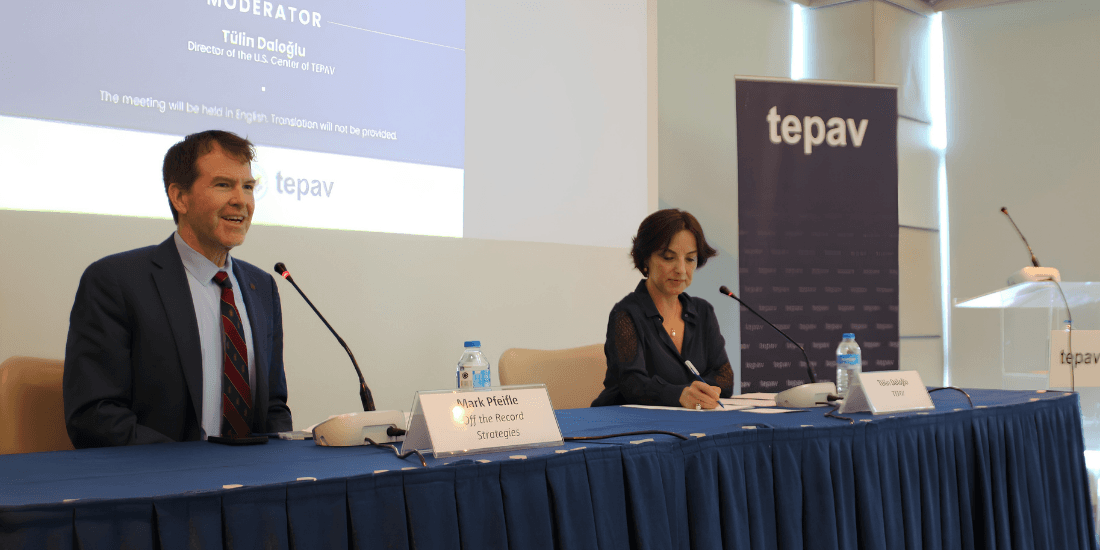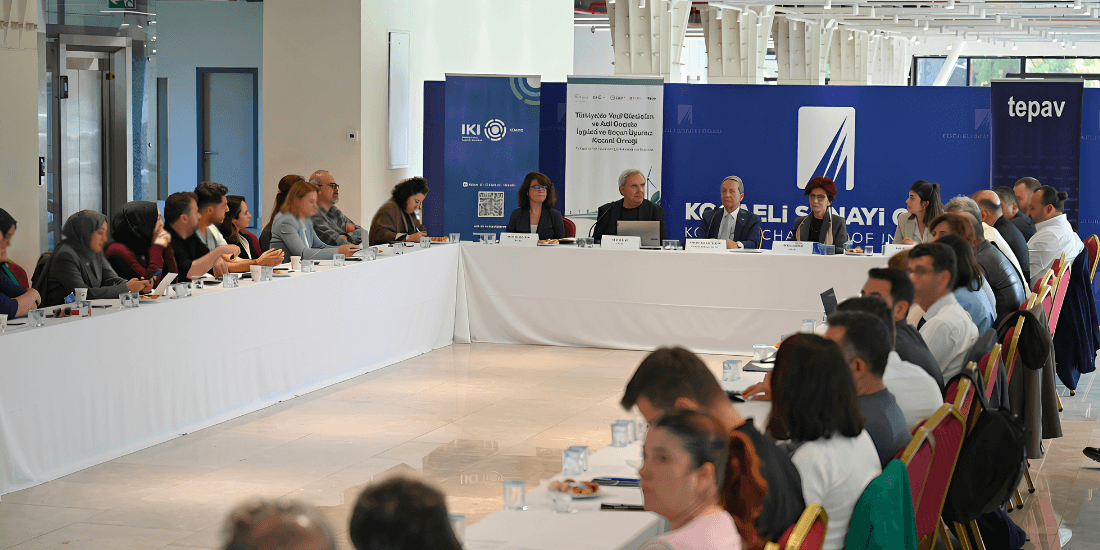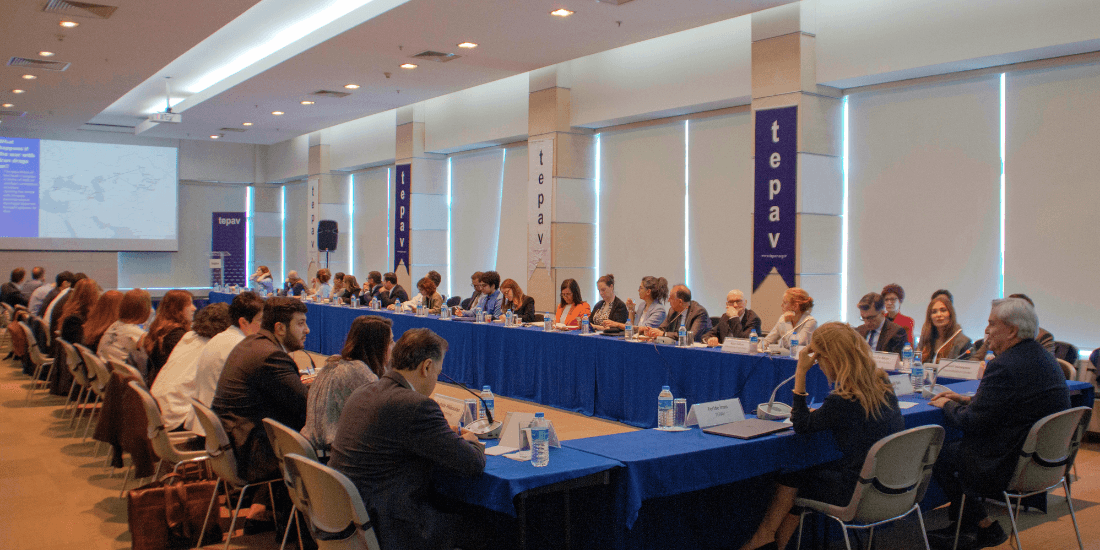
The roundtable, titled “Regional Conflicts and Changing Trade Corridors: A Window of Opportunity for the South Caucasus,” was organized by the Economic Policy Research Foundation of Türkiye (TEPAV) in Ankara on 12 May 2026. The meeting focused on geopolitical transformation in the South Caucasus, regional connectivity initiatives, and ongoing normalization processes.
The opening remarks were delivered by Güven Sak, Founding Director of TEPAV. Moderated by Feride İnan, Director of the TEPAV Center for Geoeconomic Studies, the meeting brought together Areg Kochinyan, President of the Armenian Council; Konul De Moor, Programme and Peacebuilding Officer at Conciliation Resources; Naira Sultanyan, Director of the Democracy Development Foundation; Nigar Göksel, Türkiye Director at the International Crisis Group; Philip Gamaghelyan, Director of Programs at Imagine Center for Conflict Transformation and Editor of Caucasus Edition; Rusif Huseynov, Director of the Topchubashov Center; Zaur Shiriyev, scholar at the Carnegie Russia Eurasia Center; and Anahide Pilibossian, Vice President of Strategy and Development at Applied Policy Research Institute of Armenia (APRI Armenia).
The South Caucasus’s New Geoeconomic Role Discussed
The meeting highlighted that the South Caucasus has regained strategic importance along the Europe–Asia axis amid shifting global geopolitical dynamics. It was noted that connectivity projects in the region create new opportunities not only for logistics and trade, but also for political normalization and economic integration. Participants underlined that new connectivity initiatives, particularly TRIPP, play a critical role in the region’s broader transformation.
The discussion also emphasized the importance of integrating connectivity projects with different logistics networks. Operational delays along the Caspian crossing were identified as a significant challenge to the effectiveness of existing corridors. Participants stressed the need to improve port infrastructure and logistics processes, while also noting that the region should be approached not merely as a transit route, but as a space for economic cooperation.
Economic Integration’s Contribution to the Peace Process Discussed
The meeting also addressed the potential implications of opening the Türkiye–Armenia border for the regional economy. Participants noted that the opening of the border could have significant consequences not only for bilateral relations, but also for unlocking the economic potential of Eastern Anatolia, increasing regional tourism flows, and facilitating the emergence of new trade routes. The possibility of establishing joint economic zones encompassing Nakhchivan, Türkiye, and Armenia was also among the issues discussed.
Participants further highlighted that the United States’ involvement in the TRIPP process could pave the way for new financing and cooperation models. It was emphasized that, for peace to become sustainable, regional connectivity projects must generate tangible benefits not only at the interstate level, but also for local economies and communities.
Peace Process and Connectivity Advancing in Parallel
The meeting highlighted that the increase in direct contacts between Türkiye, Azerbaijan, and Armenia in recent years, alongside the declining likelihood of renewed conflict, has marked a significant shift in the region. Participants noted that the political atmosphere in the South Caucasus has changed compared to previous periods, while discussions in Armenia on diversifying its foreign policy orientation continue.
Participants also underlined that the peace process, border delimitation efforts, and connectivity initiatives between Armenia and Azerbaijan are progressing in parallel. Issues such as negotiations on a peace agreement, border delimitation, and the reopening of transport links inherited from the Soviet period were noted as being simultaneously on the agenda.
The Regional Implications of the Normalization Process Assessed
The meeting highlighted that the opening of the region is required to reap full economic benefits. Hence, Türkiye–Armenia normalization process and the Azerbaijan–Armenia peace process cannot be considered in isolation from one another.
The discussion also underlined that the South Caucasus is increasingly shaped by the pressures of the Russia–Ukraine war and developments in Iran. In this context, participants stressed the need for new economic and diplomatic mechanisms that could strengthen regional resilience.
Against the backdrop of assessments that Georgia has become increasingly unpredictable, Armenia’s potential role as an alternative transit route was also discussed.
Attention Drawn to the Social Dimensions of Normalization
In the closing reflections, participants noted that the growing number of informal contacts between Armenian and Azerbaijani experts in recent years points to a significant transformation compared to only a few years ago. Direct engagement and expert-level dialogue were assessed as important factors strengthening the societal dimension of the normalization process.
During the Q&A session, participants focused in particular on why the Türkiye–Armenia border has not yet been opened, the feasibility of TRIPP, the relationship between the peace process and elections, and whether regional cooperation is being reduced solely to transport projects. The meeting also highlighted the direct impact of political normalization on economic initiatives, with participants noting that existing restrictions continue to increase the costs of regional trade.
Click here for Güven Sak’s presentation.