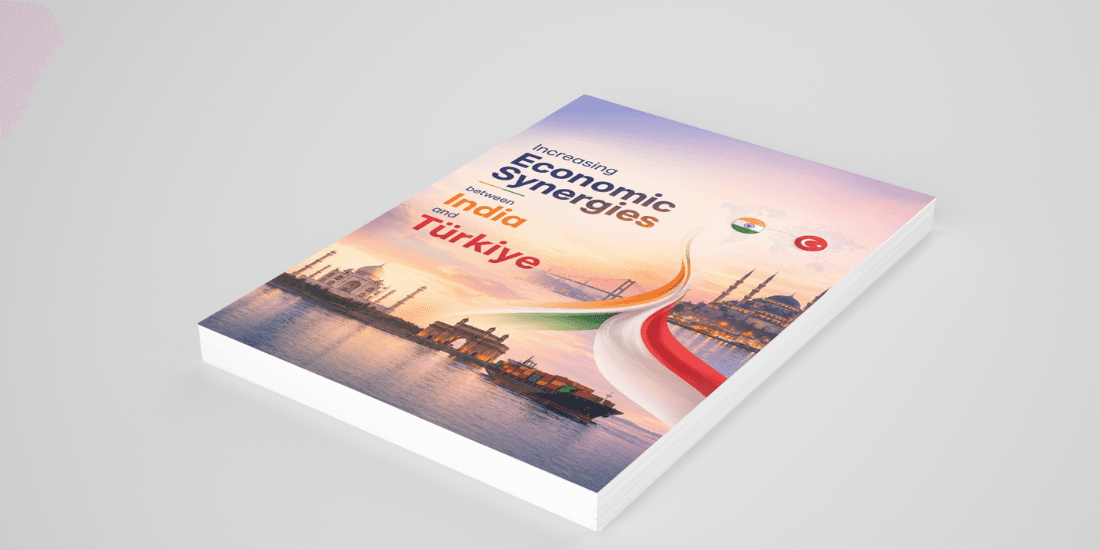
TEPAV has published a new report titled India and Türkiye: Towards a New Economic Partnership, examining the economic relationship between two major economies that have emerged as strong industrial countries following decades of economic liberalization and integration into global markets.
According to the report, Türkiye opened its economy in the 1980s, while India embarked on a comprehensive liberalization process in 1991. Since then, both countries have expanded and diversified their exports, strengthened their industrial capabilities, and increased their participation in global trade. Today, however, both face the challenge of moving up the value chain amid growing competition from Chinese manufacturers and rising uncertainties in the global trading environment.
Despite these similarities, economic ties between the two countries remain limited. Bilateral trade reached approximately USD 9.9 billion in 2024, while investment flows have remained modest relative to the size of both economies. The report notes that India and Türkiye continue to be relatively minor trading partners for one another, highlighting substantial untapped potential for deeper engagement.
Opportunities for higher value-added trade
The report identifies a range of opportunities to expand bilateral trade, particularly in medium- and high-technology sectors. Türkiye could strengthen its exports to India in areas such as machinery, vehicles, selected electronic goods, and chemicals. India, meanwhile, could expand its presence in the Turkish market through pharmaceuticals, electronics, chemicals, machinery, and automotive products.
Building on complementary strengths
A central finding of the report is that the two economies possess complementary capabilities that can support a stronger economic partnership. India has developed significant strengths in pharmaceuticals, chemicals, electronics, and digital services, while Türkiye has built competitive industries in automotive manufacturing, machinery, logistics, and sectors integrated into European value chains.
The report proposes a framework for cooperation based on leveraging these strengths. It highlights opportunities for companies from both countries to collaborate along value chains and jointly target third-country markets, particularly by combining India’s strong position in the United States with Türkiye’s integration into the European Union market.
Technology partnerships and joint innovation
Beyond trade, the report emphasizes the importance of technology cooperation and joint product development. It points to areas such as biosimilars and solar photovoltaic technologies as promising fields for collaboration, where joint innovation efforts could help both countries enhance their competitiveness and create new growth opportunities.
The report concludes that deeper economic cooperation between India and Türkiye could contribute to stronger trade and investment ties, greater technological collaboration, and improved resilience in an increasingly uncertain global economy.
You can access the report here.