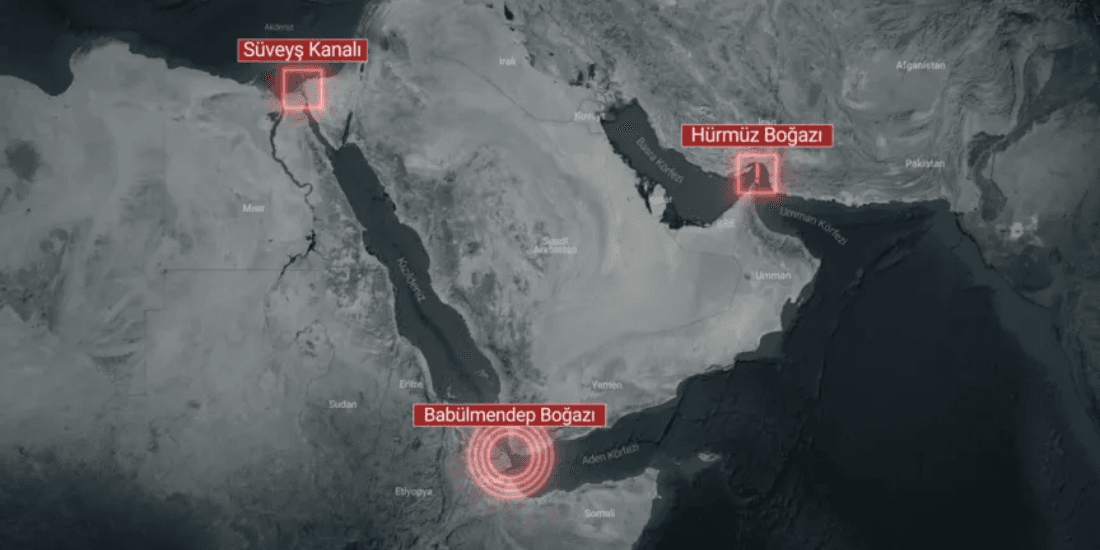

Are you aware of how much the world has changed from yesterday to today? Not for better or worse. It simply has. The Strait of Hormuz crisis that emerged after the U.S. and Israeli attack on Iran has changed our world irreversibly. Until yesterday, whenever logistics routes and trade corridors were discussed, the first thing that came to mind was always cost calculations. Not anymore. Let us take a closer look at how this has changed.
To be blocked or not to be blocked, that is the question
This is how I used to ask TEPAV researchers about these issues. “If containers take that route, what is the time cost of this choice? How many days does it take to reach the destination? That is not enough. Once this time cost is taken into account, what additional cost must be borne? What is the financial cost of that route? And even that is not enough anymore; now we also need to calculate the carbon cost.”
But look at where we are now: whether a route is safe, whether it will be blocked, and whether the goods you ship will actually reach their destination have become the number one problem. This is what life looks like after the disruption in the Strait of Hormuz.
In the past, route blockages were not an issue. Now they are. In this new situation, the best route is no longer simply the cheapest or fastest; it is the one that ultimately delivers the goods you send. There was a time when people said that the most expensive energy is the energy that does not exist. Now, the worst route is the one that simply cannot deliver the goods you set out to send. This is exactly the Strait of Hormuz effect. What does this mean? It means that we need to start rethinking trade corridors. We have now seen that choosing the Strait of Hormuz route simply because it lowers costs, and calling it the best route, actually means putting all the eggs in the same basket. Now is the time to diversify routes.
The Time Has Come to Open the Armenia-Türkiye Border
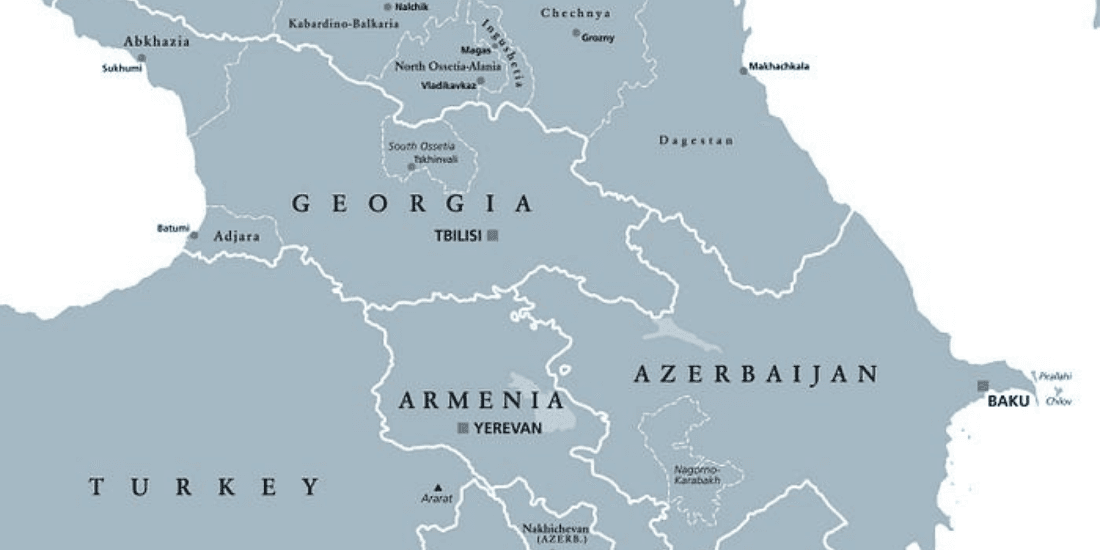
We have thus entered a new period in which trade corridors that were not seriously considered until yesterday, because they were seen as costly, will now come to the forefront. I believe that in this new period, the South Caucasus will become an important transit point. The South Caucasus includes Armenia, Azerbaijan, and Georgia. But to be honest, I mostly have Armenia and Azerbaijan in mind. The east-west axis, in particular, connects these two countries.
Take a look at the map if you like. To the north, there is the Russia-Ukraine war; to the south, there is the war involving Iran, along with the current disruption in the Strait of Hormuz. It seems that Iran’s control over Hormuz will be a central issue in Iran-U.S. peace talks. What does this mean? These peace talks will neither start easily nor end easily. What happens in this case?
The South Caucasus becomes increasingly important for both north-south and east-west connectivity. As the importance of the South Caucasus rises, Türkiye’s importance rises with it. The TRIPP connection, once referred to as the Meghri Corridor and later as the Zangezur Corridor, and now called the Trump Route, is of course also important.
Until yesterday, we used to talk about how costly the Caspian crossing was. Crossing the Caspian took one day, while handling the goods on each shore took around ten days. But in the new situation after the disruption in the Strait of Hormuz, where delivery matters more than cost, even the cost of crossing the Caspian now seems bearable. As I said, this is a different period now.
Under these new conditions, every step taken to reconsider the cost of crossing the Caspian will only strengthen the argument that the South Caucasus has become the center of the world. We are now in a favorable environment for thinking about what was unthinkable yesterday.
As the South Caucasus becomes the center of the world, it will be important to address the region’s connectivity issues one by one. Alongside the Caspian crossing and the functionality of the TRIPP route, the opening of the Armenia-Türkiye border is also among the issues that need to be addressed without delay. Let me also make that point clear.
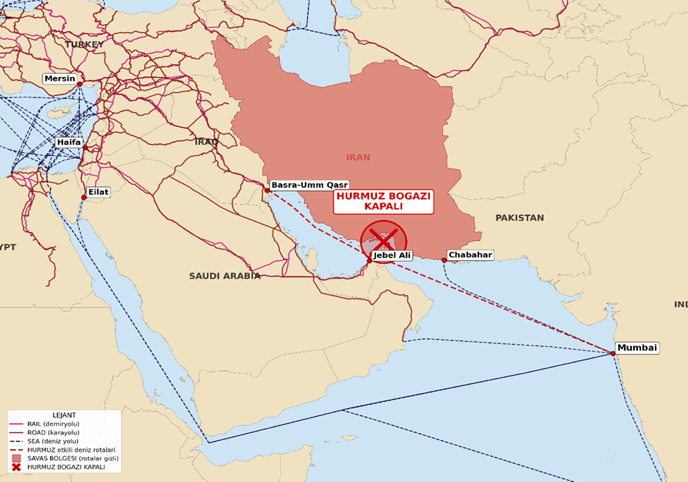
Türkiye, together with the South Caucasus, is now also positioned at the center of the world. Moreover, this will not be merely about Türkiye serving as a transit point, but also about the industrialization of Central Asia and the movement of Turkish companies in that direction. The starting point of this movement could be the free trade and industrial zones to be established along the Dilucu route toward the TRIPP route. Turkish industry will move toward Central Asia through organized industrial zones (OIZs).
Today, the issue is not only the growing uncertainty over where and how goods will be transported. The world economy is searching for direction. But it is not only the economy; the future itself is also searching for direction. Because young people, who are the future itself, are struggling to see where the road ahead will lead. Now is the time to connect Türkiye’s new position at the center of the world with a vision for 22nd-century Turkish industry. And yet, so far, there has been no real movement.
Is being young today any easier than it was yesterday?
The reference points we are used to are disappearing, and our world is changing once again. Karl Marx would have described this situation by saying, “All that is solid melts into air.” And that is exactly what is happening again. As the routes we have grown used to disappear, it is almost impossible not to feel anxious.
We need to take this situation seriously and carefully assess how young people are affected by it, especially now that social media allows them to see every part of the world at once. The figures are clear: young people’s life satisfaction is declining in Türkiye.
Habitat Association’s “Youth Well-Being Report in Türkiye” was prepared based on interviews with young people aged 18 to 29 in 18 provinces. While the level of life satisfaction stood at 70 percent in 2017, this rate declined to around 50 percent in 2026.
The same trend is also evident in Eurostat data. In 2025, the life satisfaction rate among those under 25 declined compared to 2013.
Today’s young people are more anxious than those of yesterday. Ank-Ar asked this April: “Do you think being young today is harder or easier than being young twenty years ago?” Around 2,000 people participated in the survey, and 59.9 percent said that “being young today is harder than it was twenty years ago.” Who says it is harder? Young people do. Among survey participants aged 18 to 25, the share who say “being young today is harder than it was twenty years ago” rises to 85.5 percent. Among participants aged 55 to 65, however, the share of those who say that “being young today is harder than it was twenty years ago” falls by almost half, to 40.4 percent.
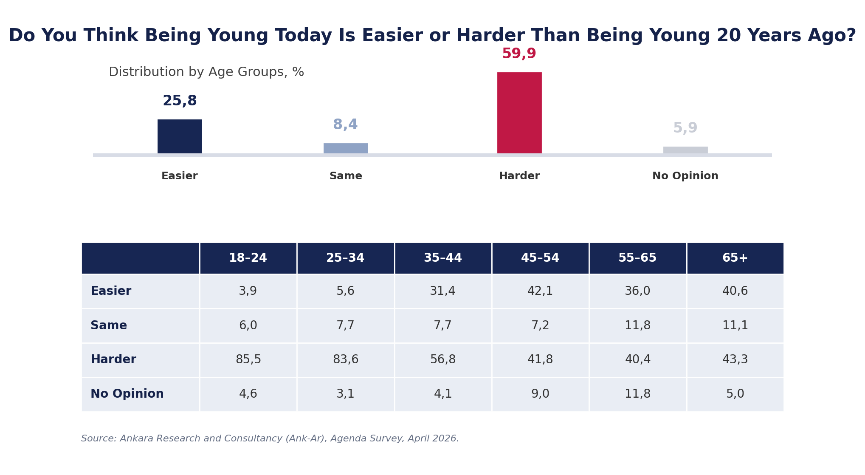
The figures had already been showing for some time that young people were anxious. The Ank-Ar figures added another layer to this picture. Why are young people anxious? About life and about the future. But I think we should also consider that older generations do not share young people’s views on this issue.
The world is becoming increasingly visible before our eyes at a rapid pace. The amount of information we need to process is rapidly expanding. We can see that all that is solid is melting into air. The reference points we are used to are disappearing, while new realities that we need to take into account are taking shape.
Türkiye needs policies that will enable us to focus not on what is disappearing or coming to an end, but on what is new and emerging. We need to look not at what is stuck in Hormuz, but at what is emerging in the South Caucasus; not at what is sinking in Dubai, but at the region’s possible new Dubais.
But none of this can be completed without giving direction to young people’s lives.
To prevent young people’s anxiety about the future and the unhappiness fed by hopelessness from turning into growing anger, it is essential to open new paths before them. Something is changing in Türkiye, and we must grasp this. The issue we face today stems from our inability to present young people with a credible vision of the future.
What we are facing, in essence, is an ideological vacuum that makes it almost impossible to feel excitement or make assessments about the future. There is no forward-looking excitement, no joy, and no enthusiasm for achieving something.
Unless policies are built that restore direction, meaning, and predictability to young people’s lives, neither the fight against drugs will produce results nor the rising wave of violence will come to an end.
Let me say it once again.