The Second TEPAV - OECD Industrial Policy Workshop was held in Istanbul
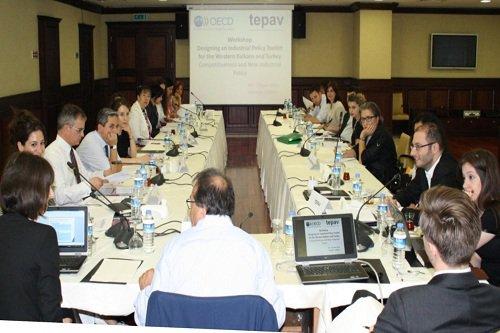
ISTANBUL- A report entitled “Designing an Industrial Policy Toolkit for the Western Balkans and Turkey” was discussed during the second workshop of the industrial policy series organized jointly by TEPAV and OECD.
Hosted by TEPAV, the workshop on 18-19 June 2014 was attended by representatives from Ministries of Development of 6 Balkan countries (Albania, Bosnia and Herzegovina, Macedonia, Kosovo, Serbia, and Montenegro) and of Turkey, and from the Central European Free Trade Agreement (CEFTA), the European Commission (EC), OECD and TEPAV. Participants discussed the draft report on “Designing an Industrial Policy Toolkit for the Western Balkans and Turkey” prepared by the OECD.
The first day of the workshop was devoted to the comparison of industrial policy approaches in the Western Balkan countries and Turkey and the potential areas for cooperation upon the analysis of similarities and differences of respective approaches. At the second day of the workshop, the draft report on industrial policy processes was assessed within the five-pillar framework it draws: analysis/diagnosis, vision strategy, policy design, implementation, and monitoring/ evaluation.
The first of the TEPAV – OECD Industrial Policy Workshop series took place in January 2014 with the theme “The New Industrial Policy of the Balkans.”
The workshop series aims at setting a roadmap for creating a conducive environment for private sector development. Successful industrial policy examples was well as the changing economic circumstances and the experiences of participant countries guide the drawing of this roadmap.