İlgili Yayın Dosyaları
Evaluation Note / Berat Yücel, Sercan Sevgili
The civil war that had been ongoing in Syria since 2011 effectively came to an end on 8 December 2024. Hayat Tahrir al-Sham (HTS), led by Ahmed al-Sharaa, brought its Idlib-centered campaign, which had begun in northwestern Syria, to a close in Damascus. As former Syrian President Bashar al-Assad departed the presidential palace in Damascus for Moscow, the profound destruction caused by nearly thirteen years of civil war remained in his wake. Loss of life and forced mass displacement caused severe and lasting damage to the country’s human capital; settlements, public service buildings, businesses, and factories were extensively destroyed, while the country’s productive capacity was severely impaired. Sanctions imposed, particularly by Western countries, also restricted access to finance, narrowed foreign trade channels, and hindered the inflow of intermediate goods, profoundly affecting the Syrian economy.
As postwar reconstruction and economic recovery have assumed greater importance in Syria, quantifying the destruction caused by the war and assessing the country’s economic recovery performance in the post-conflict period have become an important area of inquiry. In this context, international organizations, particularly the World Bank, have turned to alternative methods to measure the physical and economic losses caused by the war and to estimate national economic data that have become increasingly difficult to compile amid conflict.
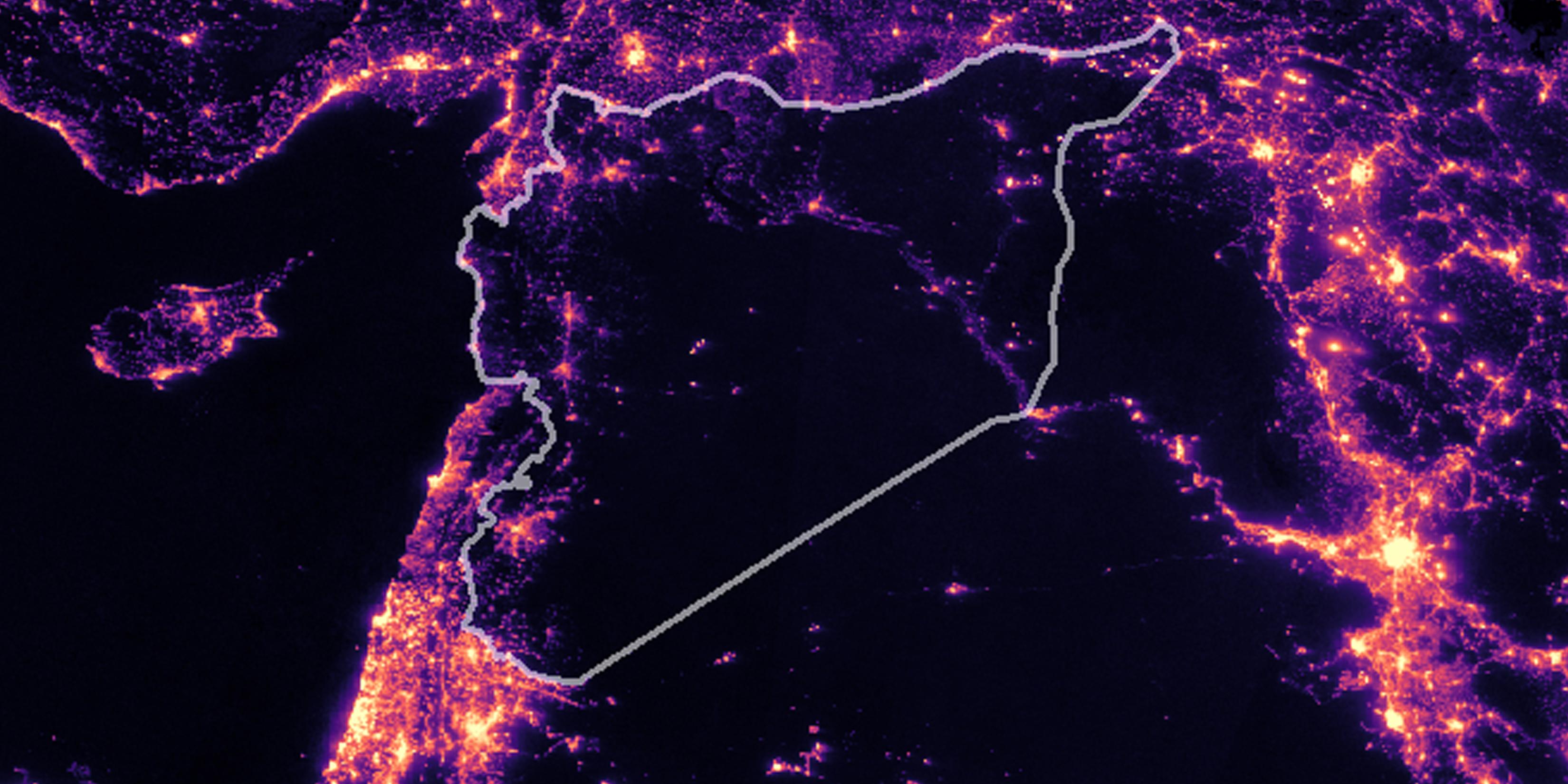
Nighttime lights data are generated from artificial light emitted from the Earth’s surface at night and captured by satellite sensors, providing a continuous indicator of the spatial distribution of economic activity. The literature has established a strong relationship between light intensity and output levels, electricity consumption, and settlement density. These data therefore serve as a useful proxy for economic activity where official statistics cannot be produced or have become unreliable. Their ability to be disaggregated by administrative unit and compiled monthly without requiring field access makes this method particularly useful in the Syrian case. Both the timing and geographical distribution of destruction can thus be monitored independently of the collapse of the national data infrastructure. Accordingly, this study assesses wartime destruction and postwar economic performance at the national and governorate levels using monthly nighttime lights data covering the period from January 2012 to June 2026. It also analyzes Syria’s economic recovery during the new administration’s first 18 months in light of the findings obtained using this methodology.
You may read note from here.