
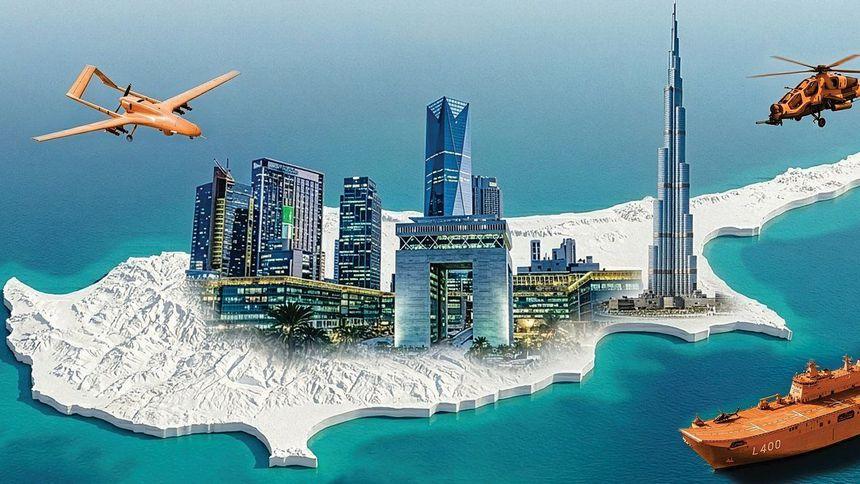
As the Iran war unsettles the fragile balance of the Gulf and erodes Dubai’s image as a safe haven, Cyprus is emerging as a strategic alternative, gaining prominence both in the region’s evolving security architecture and as a potential financial hub.
The United States and Israel struck Iran on February 28, roughly six weeks ago. Iran’s response unfolded largely in the Gulf. As of March 30, about 20 percent of Iran’s missile and drone attacks were directed at Israel, while 43 percent targeted the United Arab Emirates.
This war has already laid the groundwork for three enduring shifts in our region. Each of them points, directly or indirectly, to a question that would have seemed speculative only months ago. Could Cyprus emerge as an alternative center of gravity as Dubai’s aura fades?
The erosion of Dubai’s illusion
Dubai has long cultivated the image of a city above the clouds, insulated from the turbulence of its surroundings. That illusion has now been fundamentally shaken. In strategic terms, Dubai may well be the first casualty of the Iran war.
Anyone who has spent time there understands how carefully constructed that image was. A city of surfaces, where the spectacle often conceals a more fragile reality beneath. That delicate equilibrium has now been disturbed in a way that is unlikely to be reversed.
“Billions of dollars have been invested there,” someone remarked recently. The response is simple. Those are no longer investments in the conventional sense. They are assets exposed to geopolitical risk, vulnerable to what in military language is called collateral damage.
What many only fully grasped after Iran disrupted traffic through the Strait of Hormuz is how exposed Dubai actually is. It lies inside the Gulf, within immediate reach of one of the world’s most contested chokepoints. After this war, it is difficult to imagine a stable arrangement in Hormuz that does not involve a formal framework recognizing Iran’s role in a controlled manner.
Such transformations do not occur overnight. First, open conflict gives way to simmering tension. That phase can last years, even a decade. Eventually, it hardens into another frozen dispute. During that time, Dubai’s appeal will struggle to recover. Confidence, once broken, is not easily rebuilt.
Cyprus and the emerging security architecture
The second shift is more structural and potentially more enduring. It concerns Cyprus.
For decades, Cyprus has been described in Türkiye as an aircraft carrier anchored in the Eastern Mediterranean. The Iran war has transformed that metaphor into operational reality. In a conflict defined increasingly by missiles and drones, geography matters in new ways.
Cyprus now provides strategic depth in the interception and monitoring of aerial threats. Its location extends defensive reach toward the Levant and beyond. Recent events have demonstrated how the island and its surrounding waters contribute to the interception of projectiles heading toward Israel.
This is not a temporary advantage. As the conflict transitions from open confrontation to a prolonged standoff, Cyprus’s strategic importance is likely to increase rather than diminish. The island is becoming an integral component of a broader Middle Eastern security architecture.
At the same time, the war has underscored the growing importance of air defense systems. In an environment where missiles and drones define the battlefield, air defense is no longer a purely military concern. It has become central to economic stability.
NATO-linked systems have played a decisive role in intercepting threats in both Türkiye and Cyprus. This has reinforced the importance of the NATO umbrella, not only for defense but for maintaining economic confidence. Security and prosperity are now inseparable.
From security hub to financial alternative
This evolving strategic landscape brings us to the economic question. Could Cyprus become the new Dubai?
Two realities must be acknowledged at the outset.
First, Dubai can no longer remain the Dubai we once knew. The perception of invulnerability that sustained its rise has been damaged. Investors are unlikely to ignore the risks of operating within range of a volatile conflict zone.
Second, Dubai is not a monolith. It hosts a wide range of sectors, from logistics to finance. These will not relocate uniformly. Each will respond differently to shifting risk calculations.
One of the most significant pillars of Dubai’s success has been the Dubai International Financial Centre, or DIFC. Established in 2004, it has become a leading financial hub for the Middle East, Africa and South Asia.
Its success rests on institutional design. DIFC operates under a common law framework derived from English law, supported by an independent judiciary. This legal certainty, combined with favorable tax conditions and full foreign ownership rights, has made it attractive to global firms.
For any alternative to emerge, this legal infrastructure is essential.
Debates in Türkiye around the Istanbul Finance Center reflect this reality. Physical infrastructure alone is not enough. What is required is a parallel legal environment offering predictability, independence and international credibility. This likely means a system grounded in common law principles.
Cyprus, in this respect, holds a unique advantage.
The island already operates within a hybrid legal framework rooted in common law. In the south, English law functions alongside European Union law. In the north, the system blends English and Turkish legal traditions. This dual structure provides a ready-made institutional base for developing a financial center with international appeal.
The implication is significant. Cyprus does not need to reinvent the legal architecture that underpins financial hubs like DIFC. It already possesses much of it.
Opportunity shaped by geopolitics
The convergence of security and economic dynamics is striking.
The same geopolitical shifts that are elevating Cyprus’s importance in regional defense are also enhancing its potential as a financial and commercial hub. Stability in a volatile region becomes a comparative advantage. Legal predictability becomes a strategic asset.
Moreover, the prospect of building such a hub could create incentives for progress on the island’s long-standing political divisions. A shared economic horizon has the potential to reshape political calculations. The gains from integration into global financial networks would be substantial for both communities.
In that sense, the question is not simply whether Cyprus can replace Dubai. It is whether the changing geopolitical landscape is creating the conditions for Cyprus to assume a new role.
The answer remains uncertain. But the direction of change is increasingly difficult to ignore.