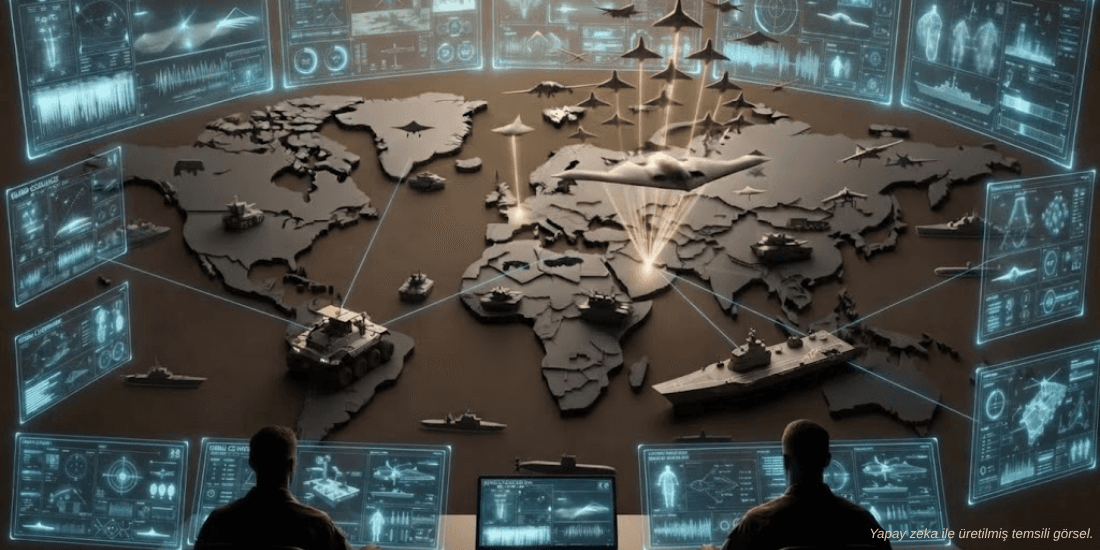
The proliferation of unmanned aerial, ground, and maritime vehicles is driving changes across numerous areas, from military doctrines and production capacity to logistics and decision-making processes. The article series prepared by TEPAV’s Security, Defense and War Studies Working Group will examine the technological, strategic, legal, and ethical dimensions of this transformation.
The first article, titled “The Strategic Power of Unmanned Systems in Reshaping the Global Order,” examines the historical development of unmanned systems, their various applications, and the potential implications of the transition to autonomous technologies for global power dynamics.
From Platforms to Ecosystems
The study emphasizes that the effectiveness of unmanned systems should be assessed not only through the technical characteristics of individual platforms but also through their sensors, communication links, data-processing capabilities, and command-and-control networks. It distinguishes between the concepts of “unmanned,” “remotely controlled,” and “autonomous,” highlighting that the absence of a human operator on board does not necessarily mean that a vehicle can make decisions independently.
Drawing on examples such as the war in Ukraine, the Karabakh War, and the use of drones by nonstate armed actors, the study examines the military implications of low-cost, widely accessible technologies. It notes that production capacity, training, logistics, electronic warfare, and military doctrines remain decisive factors in the effectiveness of unmanned systems. The ability to process data rapidly, operate multiple systems in coordination, and allocate tasks effectively between humans and machines is identified as increasingly important in shaping future power dynamics.
Civilian Applications and Autonomy
The article also explores the applications of unmanned systems in agriculture, healthcare, disaster management, mapping, and logistics. It highlights how integrating the data generated by these systems into decision-making processes could enhance their economic and social impact in civilian applications.
The study further examines the transition toward systems in which a single operator can assign tasks to multiple vehicles, enabled by advances in artificial intelligence and swarm technologies. It discusses the future of systems in which humans define overall objectives and constraints, while unmanned vehicles assume greater responsibility for task allocation, route planning, and coordination.
The subsequent articles in the series will examine how drones are transforming warfare on land, in the air, and at sea, the impact of low-cost technologies on asymmetric warfare, and their implications for the global balance of power. The series will also address the legal, ethical, and accountability issues arising from the use of autonomous weapons.
About the Security, Defense and War Studies Working Group
TEPAV’s Security, Defense and War Studies Working Group examines global, regional, and local developments from the perspectives of security, defense, warfare, and armed conflict through an interdisciplinary approach. Its main areas of research include evolving understandings of security, defense architectures, alliances, and changes in the environments and character of warfare and conflict.
The Group also focuses on a wide range of threats, from nuclear threats to terrorism, including hybrid threats, as well as deterrence and defense approaches developed in response to them. Its work encompasses defense planning, logistics, technology, intelligence, cyberspace, and outer space, while also examining the roles, institutional cultures, capacities, and functions of security institutions.
You may read note from here.