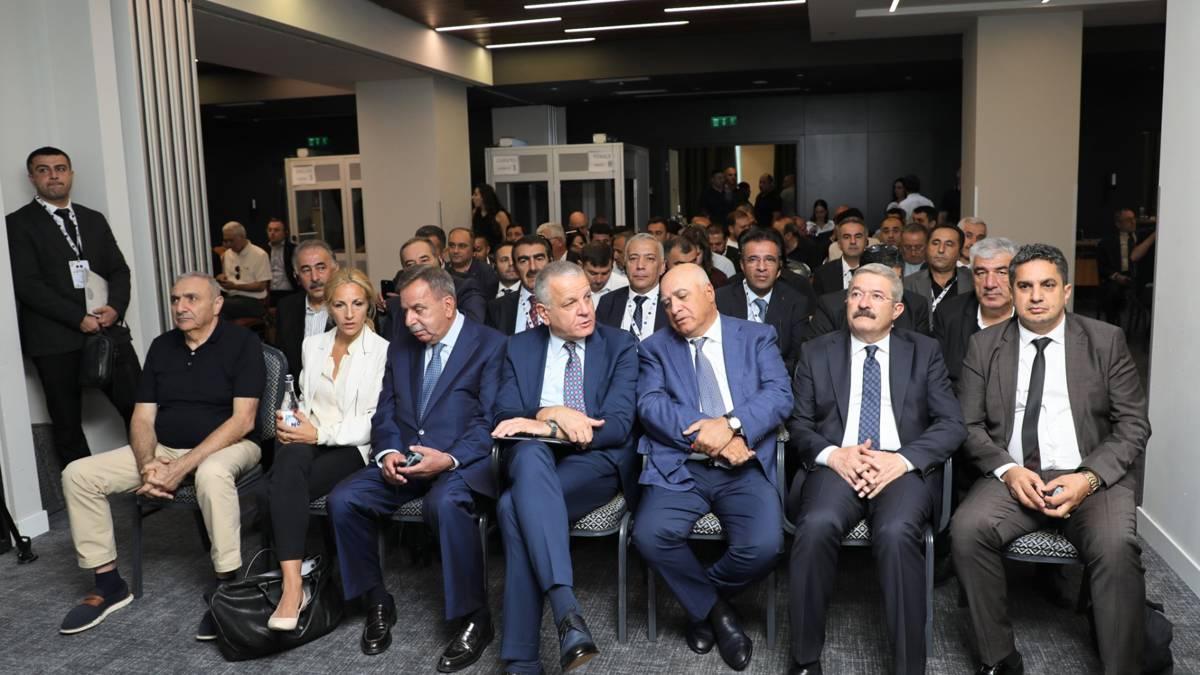
Yerevan hosted the “Türkiye-Armenia Economic Cooperation Conference” on September 3 and 4, 2026. Organized by the Economic Policy Research Foundation of Türkiye (TEPAV) and the Union of Manufacturers and Businessmen of Armenia (UMBA), the conference was held as part of the European Union-funded project entitled “Supporting Türkiye-Armenia Normalization: Strengthening Cross-Border Ties.”
The conference addressed the development of economic relations between the two countries, improvements to transportation links, and opportunities for cross-border cooperation. The program also included bilateral meetings between Turkish and Armenian business representatives from the information and communication technologies and tourism sectors.
UMBA Program Director Artur Ghazaryan opened the conference. Opening remarks were delivered by Ambassador Vassilis Maragos, Head of the Delegation of the European Union to Armenia; Arsen Ghazaryan, President of UMBA; and Necdet Takva, Chairman of the Board of the Van Chamber of Commerce and Industry.
“Contacts between business communities contribute to normalization”
Ambassador Vassilis Maragos, Head of the Delegation of the European Union to Armenia, stated that the European Union would continue to support contacts between the business communities of Türkiye and Armenia, as well as the normalization process. Noting that regional peace and normalization could foster new investment, stability, and economic opportunities, Maragos said, “The participation of Turkish business representatives in the conference in Yerevan is also an important message for Brussels.”
Maragos said that, in addition to supporting private sector development in Armenia, the EU also prioritized strengthening transportation and energy links. Referring to initiatives aimed at enhancing regional connectivity, particularly TRIPP, Maragos said, “The EU is ready to support regional cooperation in the energy sector as well as transportation infrastructure.”
“Relations between businesspeople continued even while the border was closed”
UMBA President Arsen Ghazaryan recalled that relations between businesspeople from the two countries had continued for many years despite the absence of diplomatic relations between Türkiye and Armenia and the closure of the land border. “Commercial relations between Armenian businesspeople and Turkish businesspeople, particularly those in Istanbul and Bursa, continue,” Ghazaryan said.
Emphasizing that opening the border would significantly reduce transportation and logistics costs, particularly for border regions, Ghazaryan noted that businesspeople attending the conference from Van and Iğdır would be able to reach Armenia much more quickly if the border were opened. He stated that the production and service capacities of the two countries could complement each other and that establishing diplomatic relations would also create new opportunities for joint investment.
“Trade is the force that will make normalization lasting”
Necdet Takva, Chairman of the Board of the Van Chamber of Commerce and Industry, stated that civil society and the business community had played an important role in maintaining contacts between the two societies even during periods when the border was closed. Takva also thanked TEPAV for its long-standing contributions to Türkiye-Armenia economic relations and commercial diplomacy.
Highlighting the importance of developments in direct air cargo transportation and trade facilitation within the Türkiye-Armenia normalization process, Takva said, “The real force that will make the path opened by diplomacy lasting and create prosperity for societies is trade.”
Takva stated that opening the border to trade would reduce the additional logistics and re-export costs arising from transporting goods between Türkiye and Armenia via Georgia or Iran. He emphasized that the production capacities of the two countries could complement each other rather than compete.
“New connectivity projects offer an opportunity for regional economic integration”
Feride İnan, Director of the TEPAV Center for Geoeconomic Studies, spoke alongside UMBA President Arsen Ghazaryan, President of the Iğdır Industrialists' Association Ziya Yiğit, and Necdet Takva, Chairman of the Board of the Van Chamber of Commerce and Industry, on the panel entitled “Türkiye-Armenia Economic Cooperation: Next Steps?”
İnan explained that TEPAV's work on Türkiye-Armenia relations began in 2008 with initiatives to restore the Ani Bridge, and that various projects aimed at advancing economic relations between the two countries were subsequently carried out under EU programs. She stated that TEPAV continued its efforts under the current program to promote cooperation in tourism and information and communication technologies.
“Connectivity investments should be supported by production capacity”
Noting that the prospect of opening the Türkiye-Armenia border was stronger than it had been in many years due to the changing situation in Karabakh and developments in the normalization process, İnan said, “New connectivity initiatives such as TRIPP and the Crossroads of Peace should be viewed not only as alternative transportation routes, but also as instruments of economic diversification and regional integration in Eastern Anatolia, the South Caucasus, and Central Asia. Türkiye's industrial capacity and integration with European value chains could help connect the region to European and global value chains. To translate this potential into concrete economic outcomes, it is necessary to institutionalize business dialogue, support connectivity investments with economic activity and production capacity, and strengthen cooperation in areas such as customs modernization and trade facilitation alongside transportation infrastructure.”
Noting that Türkiye's organized industrial zones could provide a model adaptable to the South Caucasus, İnan said that tourism could serve as an important starting point for strengthening public support for the normalization process.
Border regions and complementary economic relations featured prominently in the panel
During the panel, UMBA President Arsen Ghazaryan noted that the economies of Türkiye and Armenia had areas in which they could complement each other. Citing Turkish demand for aluminum foil produced in Armenia as an example, Ghazaryan said, “In the past, Turkish agricultural products reached third markets through Armenia. The potential for cooperation between the two markets should be developed. Turkish investments should not be viewed as a threat to the Armenian economy. Companies from the two countries can enter third-country markets together.”
Necdet Takva stated that the business community should play a more active role in advancing economic relations, adding that developing legitimate trade channels could encourage decision-makers to support normalization. Describing reciprocal visits by business representatives from the two countries as an important starting point, Takva said, “In areas where it is competitive, Armenia can access the Turkish market and, through Türkiye, wider markets.”
Ziya Yiğit, President of the Iğdır Industrialists' Association, also highlighted the Iğdır business community's interest in developing economic relations with Armenia. Recalling their visit to Armenia in May with a group of businesspeople from Iğdır, Yiğit stated that developing economic relations was a long-term process but that mutual contacts represented an important starting point. Pointing to the geographical proximity between Iğdır and Yerevan, Yiğit emphasized that cultural and social relations also needed to be strengthened for commercial relations to advance.
Business representatives held bilateral meetings
The findings of the study entitled “Opportunities and Existing Barriers in Türkiye-Armenia Transportation Links” were also shared with participants during the conference. Existing barriers to transportation links and the economic opportunities that could emerge if the border were opened were assessed.
Later in the program, businesspeople from Türkiye and Armenia came together for bilateral business meetings. Focusing particularly on information and communication technologies and tourism, the meetings addressed new business connections and potential partnerships. Engagements on the second day of the conference continued as part of Armenia Expo 2026.